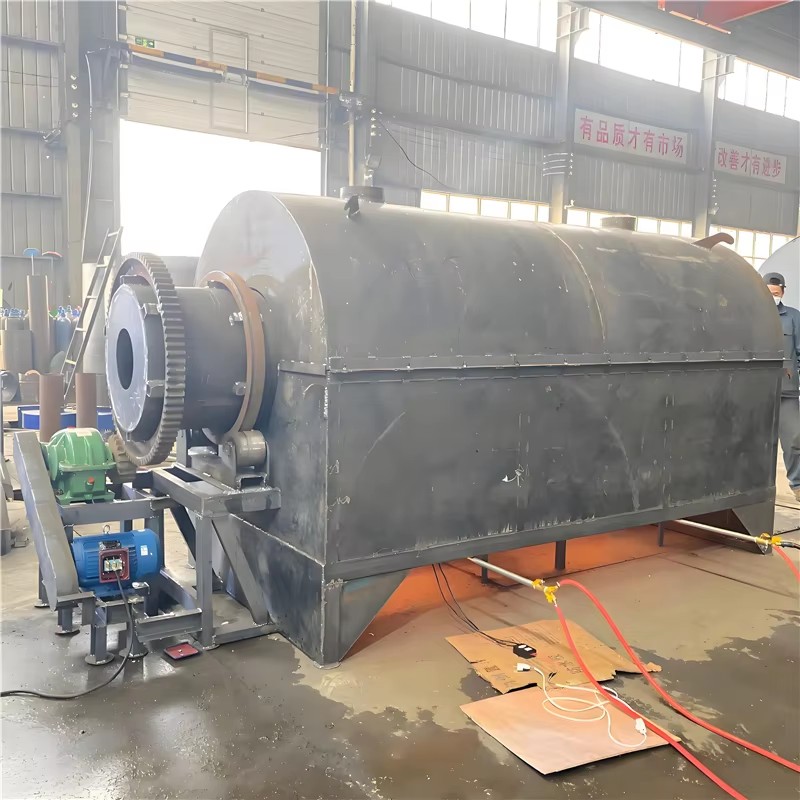
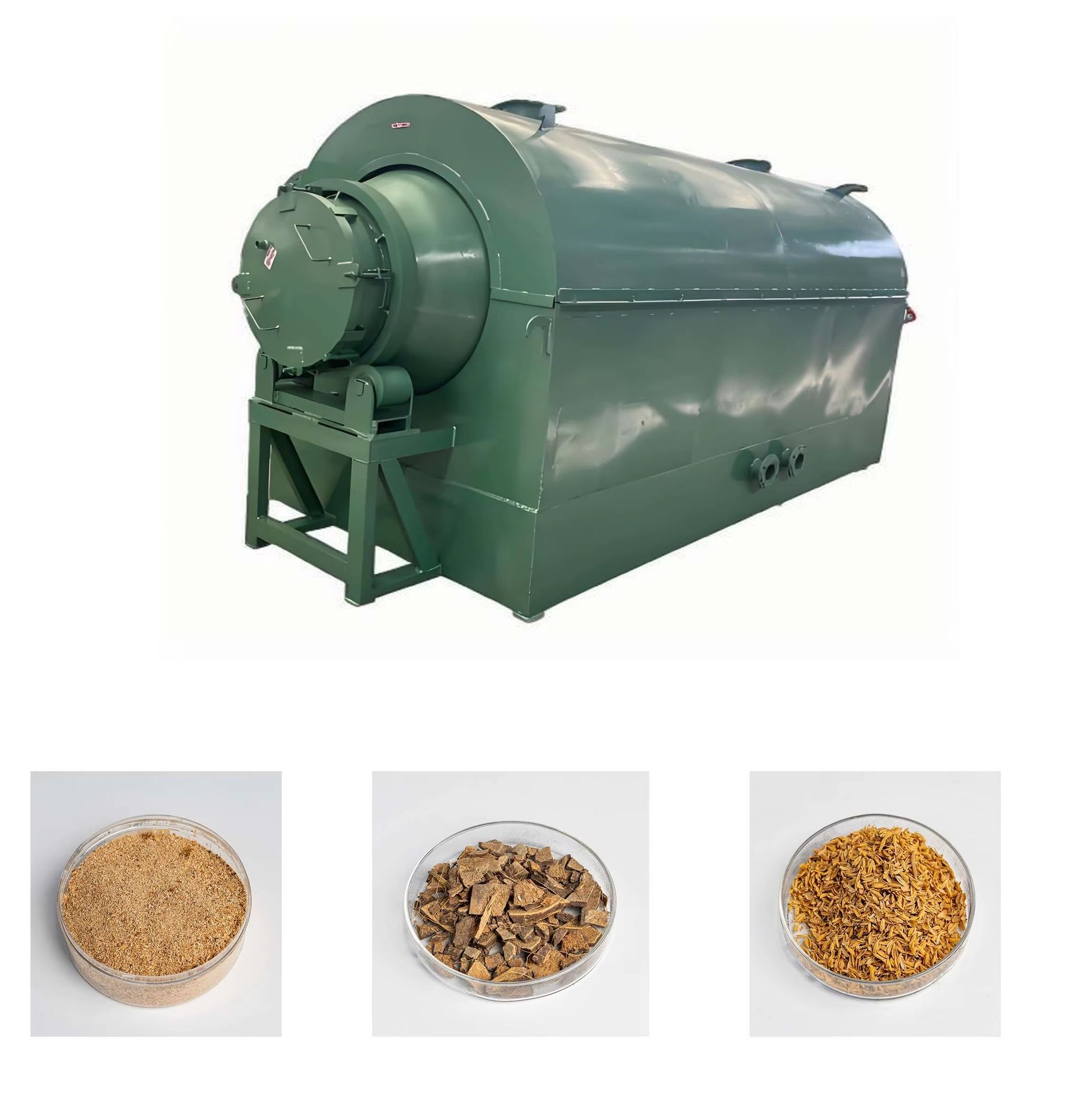
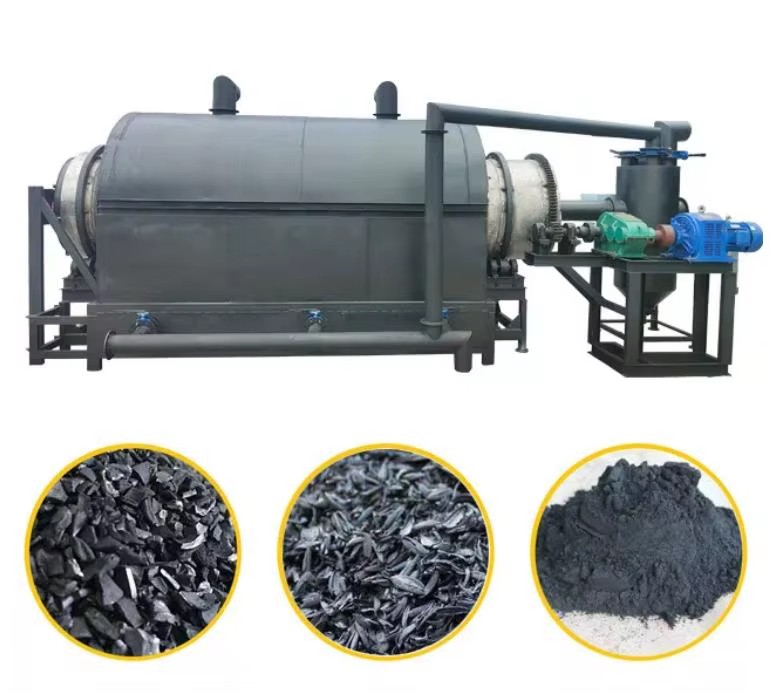
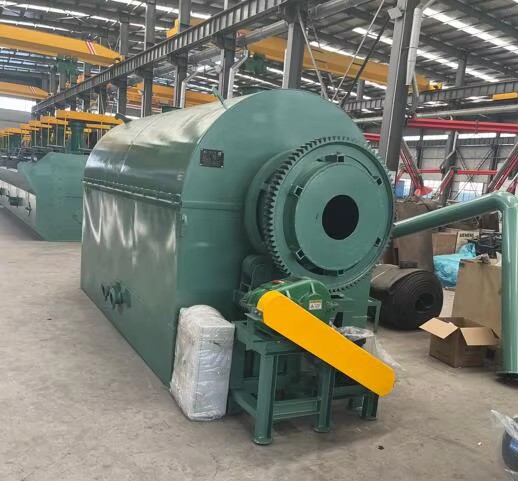
Product introduction: The small continuous carbonization furnace's overall shape is cylindrical, and its appearance is sturdy and durable. It is mainly composed of a rotary furnace body, a transmission device, a heating system, a feeding system, a discharging system, and various auxiliary devices.
1. The rotary furnace body is the core part of the equipment. It is usually made of high-quality steel and can withstand high temperatures and long-term operation. Its internal space is reasonably designed, providing sufficient space for the drying and carbonization process of the material. The furnace body is 4.4 × 1.5 × 2.1 m in length. This specification allows the equipment to have a relatively compact structure while ensuring the processing capacity, which is convenient for installation and space layout.
2. The transmission device is located on one side of the furnace body and is connected to the furnace body through gears and other components. It is responsible for driving the furnace body to rotate. The transmission device is equipped with a 5.5 kW (variable frequency) motor, which can flexibly adjust the speed according to actual production needs to ensure that the material is evenly processed in the furnace. The motor uses three-phase AC and a voltage standard of 380V to ensure the stability of the equipment's operation.
3. The heating system is the key to achieving carbonization of materials. The heating method of this equipment is flexible and diverse. Heat can be provided by burning wood, liquefied or natural gas (an additional burner is required). During the heating process, the temperature in the furnace can be stably controlled at 250° - 300°, and the oxygen-free carbonization method is adopted to create suitable conditions for the carbonization of materials.
4. The feeding system and the discharging system are located at both ends of the furnace body. The feeding system is responsible for conveying materials that meet the requirements into the furnace, and the discharging system discharges the finished products after the carbonization of the materials is completed. The working principle of the main machine is clockwise feeding (carbonization process) when rotating forward, and counterclockwise unloading when reversing. This design makes the feeding and discharging process proceed in an orderly manner and improves production efficiency.
In addition, the equipment is also equipped with a series of auxiliary devices, such as wood tar and wood acetic acid collection systems, a flue gas cooling device, a purification system, and a thermometer with a display function. These auxiliary devices cooperate, which not only helps to improve the quality and added value of the products, but also effectively treats the waste gas and other by-products generated during the production process, and achieves the production goals of environmental protection and energy saving.
As a powerful and widely used equipment, the small continuous carbonization furnace is gradually becoming a powerful assistant in many industries. It has many related names, such as Rotary coconut wood carbonization furnace, Charcoal carbonization furnace, Shell Carbonization Furnace, Wood Carbonization Furnace, Coconut Carbonization Furnace For Sawdust, etc., which reflect its application scope and functional characteristics from different angles.
Working principle: The working process of the small continuous carbonization furnace is based on the principle of pyrolysis. By subjecting the material to high-temperature oxygen-free treatment, a series of physical and chemical changes occur, and it is finally converted into a carbonized product.
When the materials that meet the requirements, such as sawdust, wood chips, coconut shells, nut shells and other biomass raw materials, whose moisture content is within 40% and particle size is less than 50 mm, enter the rotary furnace body through the feeding system, the furnace body starts to rotate under the drive of the transmission device. At this time, the heating system starts to gradually increase the temperature in the furnace to 250° - 300°. During the rotation process, the material keeps rolling and moving in the furnace, fully contacting the hot air to achieve uniform heating.
As the temperature rises, the moisture in the material is first evaporated and discharged to complete the drying process. Then, in an oxygen-free environment, the organic components in the material begin to undergo a pyrolysis reaction, gradually decomposing and converting into by-products such as charcoal, combustible gas, and some tar. The generated flue gas enters the purification system and flue gas cooling device through the pipeline. After treatment, the combustible gas obtained by diversion can be recycled as fuel for the combustion and heating of the equipment itself, realizing the recycling of energy, which reflects the energy-saving characteristics of the equipment.
When the material completes the carbonization process in the furnace, the main engine is reversed by controlling the counterclockwise rotation to discharge the carbonized finished product from the discharging system. During the entire working process, the thermometer with a display function monitors the temperature in the furnace in real time. The operator can adjust the power of the heating system in time according to the temperature change to ensure that the carbonization process is stable and efficient.
Product raw material selection: 1. Applicable raw material types: The applicable raw materials of the small continuous carbonization furnace are extremely wide, covering a variety of biomass materials and some wastes.
Biomass raw materials are its main processing objects, including sawdust, rice husks, branches, straw, bamboo, peanut shells, coconut shells, palm shells, fruit shells, etc. These biomass materials exist in large quantities in agriculture, forestry, and daily life. In the past, most of them were treated as waste, which not only took up a lot of space, but also may have caused certain pollution to the environment. Through the treatment of the small continuous carbonization furnace, they can be converted into carbonized products with economic value to achieve resource recycling.
In addition, the equipment can also process some special raw materials, such as capacitors, circuit boards, electronic waste, scrap metal, etc. When processing these wastes, the equipment can not only carbonize them, but also remove coatings such as paint to achieve deep treatment of waste and resource recovery. This adaptability to a variety of raw materials makes the small continuous carbonization furnace have important application value in the field of comprehensive resource utilization.
2. Raw material characteristics requirements: There are clear characteristics requirements for the raw materials of small continuous carbonization furnaces. In terms of moisture content, the moisture content of the raw materials is required to be within 40%. This is because too high a moisture content will increase the time and energy required for material drying, extend the entire carbonization cycle, and reduce production efficiency. At the same time, too much moisture may also affect the stability of the carbonization process, resulting in a decrease in product quality.
In terms of particle size, the raw material particle size must be less than 50 mm. The appropriate particle size can ensure the uniform distribution and sufficient heating of the material in the furnace, making the carbonization reaction more uniform and uniform. If the raw material particle size is too large, it may cause uneven heating in the furnace, and some materials cannot be fully carbonized, affecting the quality and output of the product; if the particle size is too small, it may cause problems such as blockage of the material during feeding and discharging, affecting the normal operation of the equipment.
Product advantages: 1. The small continuous carbonization furnace has the characteristics of efficient and continuous production. Its capacity is 300-500kg/h, and it can process a large amount of materials per unit time. Compared with traditional intermittent carbonization equipment, the continuous production mode greatly improves production efficiency, reduces waiting time in the production process, and can meet the needs of large-scale production enterprises.
In the continuous production process, the various systems of the equipment work together, and the feeding, carbonization, and discharging links are closely connected, realizing the automation and continuity of production. The operator only needs to regularly check the operation of the equipment and make necessary parameter adjustments and maintenance to ensure the stable operation of the equipment, reduce the intensity of manual labor, and improve the stability and consistency of production.
2. Energy saving and environmental protection are the outstanding advantages of small continuous carbonization furnaces. In terms of energy utilization, the equipment recycles the generated flue gas and uses the diverted combustible gas as fuel for its combustion and heating, which greatly reduces dependence on external energy and reduces energy consumption costs. This way of energy recycling not only improves energy utilization efficiency, but also meets the requirements of today's society for energy saving and environmental protection.
In terms of environmental protection, the equipment is equipped with a complete purification system and flue gas cooling device, which can effectively treat the waste gas generated during the production process, remove harmful substances from it, and make the waste gas emissions meet environmental protection standards. At the same time, the equipment is pollution-free during operation and will not cause secondary pollution to the surrounding environment, creating a good production environment for the enterprise and meeting the country's strict requirements for environmental protection.
3. The small continuous carbonization furnace has strong versatility and adaptability. It can handle many different types of raw materials, whether it is biomass materials or some special wastes, and can be effectively carbonized. For different types of biomass raw materials, the equipment can adjust parameters such as carbonization temperature and time to achieve the best carbonization effect and produce high-quality carbonized products.
In addition, the equipment also has functions such as paint removal, which can process some raw materials with coatings on the surface, broadening its application range. This multifunctional and adaptable feature enables the small continuous carbonization furnace to play an important role in different industries and fields, meeting the diversified needs of the market.
4. The operation of the equipment is relatively simple, and the forward feeding and reverse unloading design of the main machine is simple and easy to understand, and the operator can master it after simple training. The thermometer and control panel with display function enable operators to monitor and adjust key parameters such as furnace temperature in real time to ensure the smooth progress of the carbonization process.
In terms of maintenance, the small continuous carbonization furnace has a reasonable structural design, and each component is easy to disassemble and install, which is convenient for daily inspection, cleaning, and maintenance. The key components of the equipment, such as the transmission device and heating system, have been carefully designed and selected, with high reliability and stability, reducing the probability of failure.
Product application
1. In the field of biomass energy, small continuous carbonization furnaces play an important role. By converting biomass raw materials such as sawdust, rice husks, and branches into charcoal, these charcoals can be used as a clean energy for heating, cooking, and other living purposes, and can also be used as industrial fuels in some industrial production processes that do not require particularly high fuels.
At the same time, in biomass power generation projects, carbonized charcoal can be used as an auxiliary fuel and mixed with other biomass fuels to improve power generation efficiency. In addition, the combustible gas generated by the equipment in the process of processing biomass raw materials can also be directly used as energy, further improving the comprehensive utilization efficiency of biomass energy and providing strong support for the development of the biomass energy industry.
2. In the field of environmental protection and waste treatment, small continuous carbonization furnaces can be used to treat a large amount of biomass waste and some special waste. For wastes such as straw and branches generated in agricultural and forestry production, carbonization treatment can not only reduce the environmental pollution caused by the accumulation and incineration of waste, but also convert it into valuable carbonized products to realize the resource utilization of waste.
When dealing with special waste such as electronic waste and scrap metal, the equipment can remove coatings such as paint, deeply treat the waste, recycle useful resources in it, and reduce the harm of waste to the environment. At the same time, the waste gas generated by the equipment in the process of treating waste is purified and discharged in compliance with environmental protection requirements, which has contributed to the environmental protection cause.
3. In the field of industrial production, the carbonized products produced by small continuous carbonization furnaces have a wide range of applications. For example, in the metallurgical industry, charcoal can be used as a reducing agent to participate in the metal smelting process; in the chemical industry, the carbonized material can be used as a catalyst carrier or reaction raw material for the production of various chemical products.
In addition, some shell raw materials can be made into activated carbon after carbonization. Activated carbon has strong adsorption properties and can be used in sewage treatment, air purification, food decolorization, and other industrial production links, providing important raw material support for industrial production.
4. In the agricultural field, the carbonized products produced by small continuous carbonization furnaces can be used to improve soil quality. Applying biomass charcoal to the soil can increase the air permeability and water retention of the soil, improve soil structure, and increase soil fertility. At the same time, biochar can also absorb harmful substances in the soil, reduce soil pollution, create a good soil environment for the growth of crops, and promote the growth and increase of crops.
In addition, in some agricultural production processes, such as seedling cultivation and greenhouse cultivation, carbonized biomass materials can be used as covering or filling materials to play a role in heat preservation and moisture retention, regulate soil temperature and humidity, and are conducive to seed germination and seedling growth.
Product maintenance
1. Daily maintenance is the basis for ensuring the normal operation of a small continuous carbonization furnace. Every day before the equipment is operated, the operator needs to conduct a comprehensive inspection of the equipment. Check whether the gears, chains and other parts of the transmission device are loose or worn, and adjust and lubricate them in time; check whether the burners, pipes, etc. of the heating system are normal to ensure smooth fuel supply; check whether the feeding system and the discharging system are blocked to ensure the normal transportation of materials.
During the operation of the equipment, pay close attention to the thermometer with a display function to ensure that the temperature in the furnace fluctuates within the set range. At the same time, pay attention to the operating sound and vibration of the equipment. If any abnormality is found, the equipment should be stopped and checked in time, and the fault should be eliminated before continuing to operate.
After the equipment is operated every day, the equipment should be cleaned. Clean the dust and debris on the surface of the furnace body, especially the residual materials near the feed and discharge ports; check the auxiliary devices, such as wood tar and wood acetic acid collection systems, flue gas cooling devices, etc., and clean the sediments therein to ensure their normal operation.
2. Regular maintenance can extend the service life of the equipment and improve its performance and reliability of the equipment. Every once in a while (such as once a month), the equipment needs to be fully inspected and maintained. Perform deep maintenance on the transmission device, replace severely worn gears, chains, and other parts, and reapply lubricants to ensure smooth operation of the transmission system.
Check the burners, pipes, valve, and other parts of the heating system, clean carbon deposits and dirt, and check their sealing and safety. Check the rotary furnace body to see if the refractory materials inside the furnace body are damaged or detached, and repair or replace them in time if necessary.
Regularly calibrate thermometers and other monitoring instruments with display functions to ensure accurate measurements. Check the lines and components of the electrical system to see if they are aging, damaged, etc., and replace and repair them in time. At the same time, conduct a comprehensive inspection and maintenance of the equipment's ancillary devices, such as cleaning the filters of the purification system and checking whether the storage containers of the wood tar and wood acetic acid collection systems have leaks.
Product technical information
| Model | Capacity | Carbonization temperature | Raw material requirements | Power | Size | Weight |
| MCLF-300 | 300-500kg/h | 250°-300° | moisture content within 40%, particle size: <50mm | 5.5kw | 4.4*1.5*2.1m | 2500kg |
Product packaging picture
After-sales service
We have formed a professional after-sales team, including mechanical and electrical engineers and process experts, who have rich knowledge and experience in small continuous carbonization furnaces. We have a 7×24-hour after-sales hotline to respond to customer needs in a timely manner. Problems that can be solved by
Founded in 2006, is a professional manufacturer integrating R&D, production, and trade. Over the years, we have been committed to the R&D of feed machinery production lines, fruit and vegetable processing machinery production lines, agricultural machinery production lines, and packaging machinery production lines. The company has an R&D team of 80 employees and 16 technicians. Therefore, we have strong competitive strength, advanced processing technology, and scientific management. The company is located in Zhengzhou City, Henan Province, which is the commercial and economic center of Zhengzhou with convenient transportation. Our international airport is Zhengzhou Xinzheng International Airport.