
Product Description
HXJQ
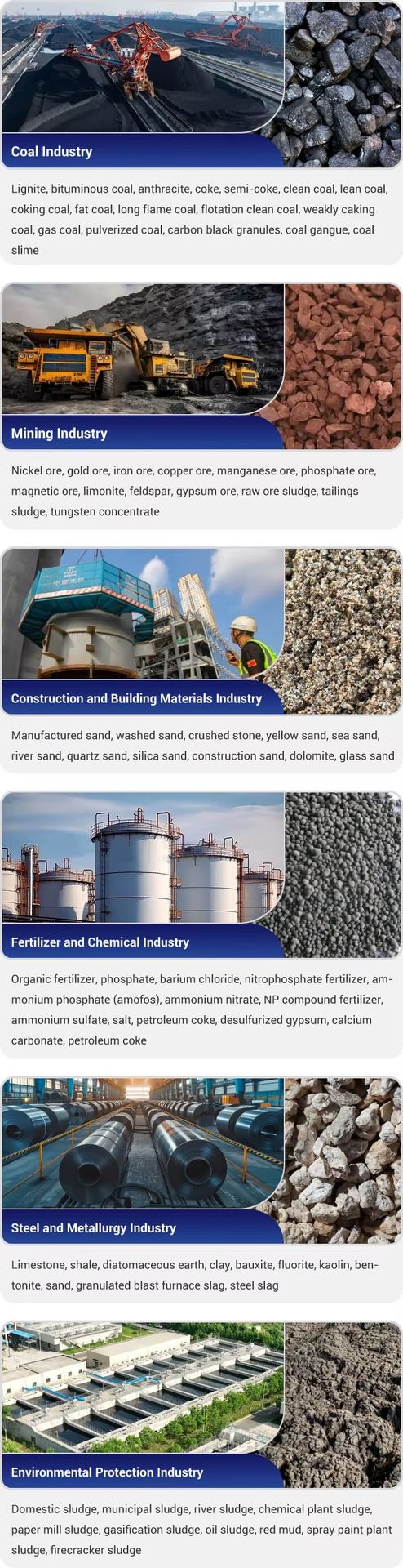
1. The rotary dryer is a high-capacity, wide-ranging industrial continuous drying equipment. It is primarily used in industries such as mineral processing, building materials, metallurgy, and chemicals to dry granular and muddy materials with certain moisture and particle sizes (less than 50 mm). The final moisture content of the dried product is typically 0-1%, and can be adjusted as needed.
2. It is suitable for various production lines, including ore beneficiation, powder grinding, pellet production, gypsum production, and cement production lines. With strong practicality, the rotary dryer stands out from ordinary dryers by increasing output while reducing coal and electricity consumption, making it a highly efficient and energy-efficient drying equipment favored by users today.
Application field
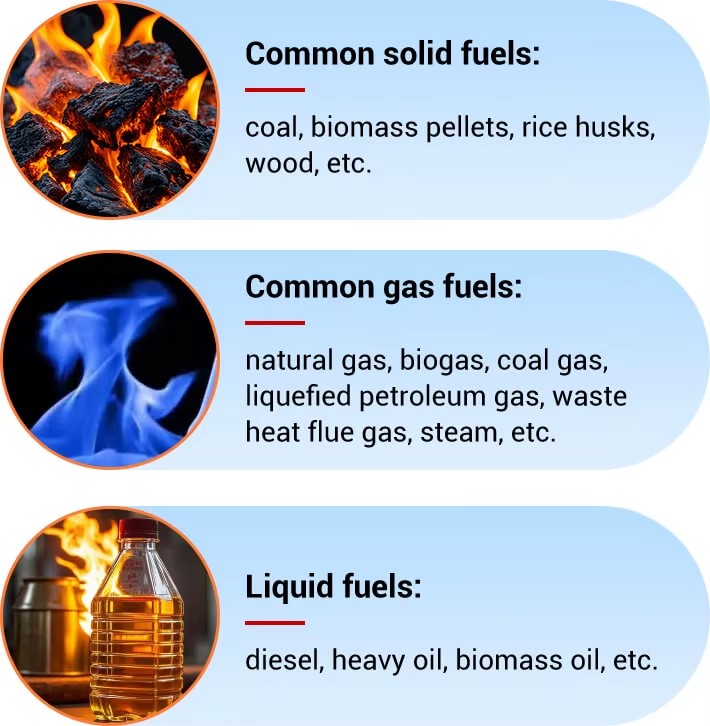
Heat Source
The dryer supports multiple heat sources with easy switching. The choice of heat source depends on the customer’s their fuel source, environmental impact assessment requirements, equipment investment costs, and production costs.
Currently, the main heat sources are classified into the following three types
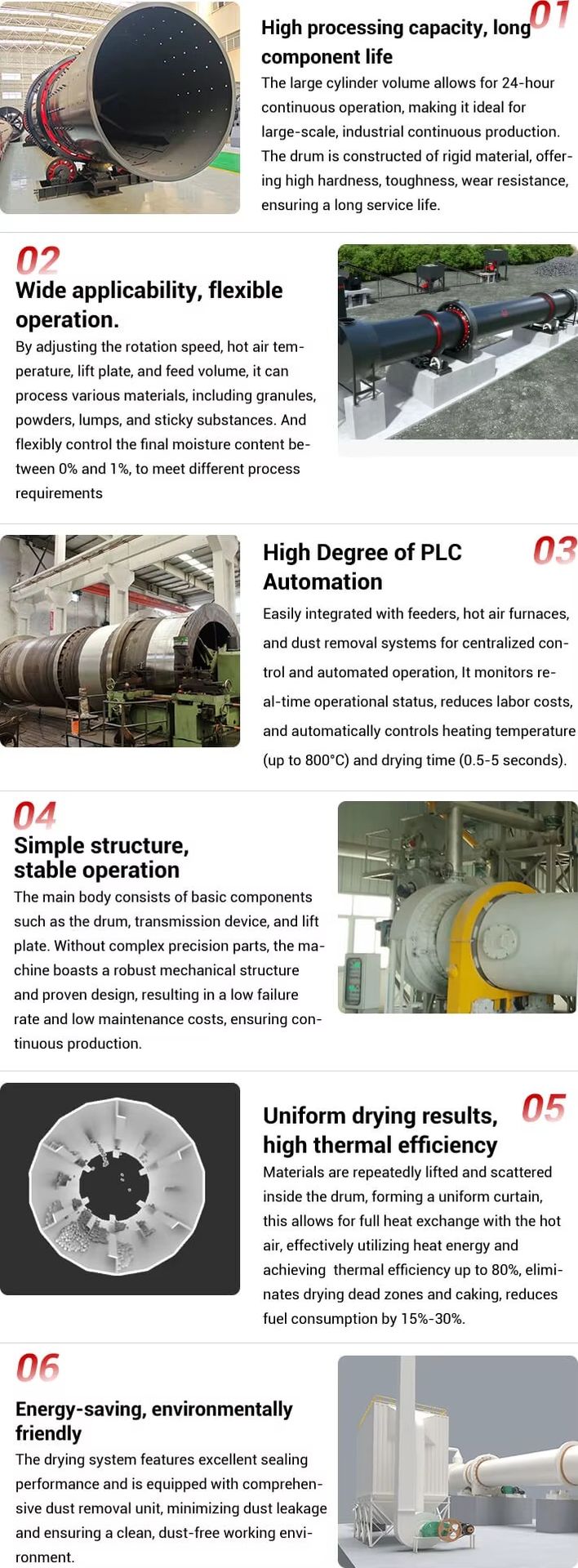
Product Features
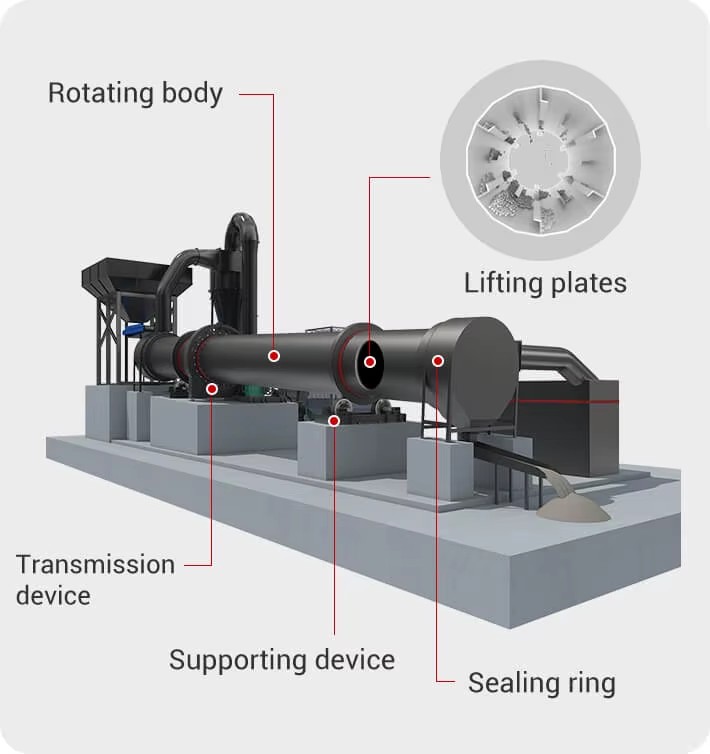
Product Structure
The rotary dryer adopts an assembled structure, consisting of a rotating body, lifting plates, transmission device, supporting device, sealing ring, auxiliary equipment (feeder, feeding conveyor, discharging conveyor, induced draft fan, hot air furnace and dust collector), making it easy to transport and install.
1. Rotating Body: Made of alloy steel plate. The feed end is welded with a spiral plate (to facilitate feeding), the middle of the cylinder is welded with lifting plates (material is lifted), and the discharge end is welded with an annular material blocking ring (to prevent the material from being thrown out before reaching the humidity). The cylinder has an inclination of 5 degrees from the horizontal.
2. Supporting Device: Composed of rollers, blocking wheels, supporting wheels, etc. The roller is sleeved around the cylinder and rotates with the cylinder. The supporting roller supports the barrel, while the blocking wheel prevents the dryer from moving forward and backward.
3. Transmission Device: Including large gears, small gears, motors, and gear reducers. Using brand motor ensures the service life of the dryer and don’t affect production due to power supply.
4. Lifting plates: Welded in the barrel, or bolted (convenient to replace the lifting plate). The angle of the lifting plates is 90°, 135°, 150°, etc. Multiple combination lifting plates can fully contact the materials with the heat inside the dryer, improve drying efficiency and reduce energy consumption.
5. Sealing sheet: The stainless-steel sheet(with good elasticity and heat resistance) has good tracking and adaptability to the beating of the cylinder during operation, providing good sealing performance and reducing heat loss. Generally, around 200 pieces, different models vary.
Working Principle
As the material enters the drum and moves along its axial direction, it receives heat from the cylinder and exchanges heat with the hot air as it is lifted and falled repeatedly by the lifting plate. As the wet material is heated, moisture evaporates from the wet material, gradually reducing its moisture content and achieving the desired drying effect.
There are two heat transfer methods: co-current flow and counter-current flow. Co-current: The material feed direction and air intake direction are aligned. This method is suitable for materials with relatively low drying requirements (e.g., 10%, 15%, or 20%) or lightweight materials.
Counter-current: The material feed direction and air intake direction are opposite. This method is used when a lower final moisture content (below 5%) is required.
Technical Data
| Spec./m | Capacity(t/h) | Highest Inlet Air Temperature |
| Φ 1.2×8 | 1.9-2.4 | 700-800 |
| Φ1.2 ×10 | 2.4-3 | 700-800 |
| Φ 1.5×12 | 4.5-5.7 | 700-800 |
| Φ 1.5×14 | 5.3-6.6 | 700-800 |
| Φ1.5×15 | 5.7-7.1 | 700-800 |
| Φ 1.8×12 | 6.5-8.1 | 700-800 |
| Φ 1.8×14 | 7.6-9.5 | 700-800 |
| Φ 2.2×12 | 9.7-12.2 | 700-800 |
| Φ 2.2×14 | 11.4-14.2 | 700-800 |
| Φ 2.2×16 | 13-16.2 | 700-800 |
| Φ 2.4×14 | 13.5-16.9 | 700-800 |
| Φ 2.4×18 | 17.4-21.7 | 700-800 |
| Φ 2.4×20 | 19.3-24.1 | 700-800 |
| Φ 2.4×22 | 21.2-26.5 | 700-800 |
| Φ 2.6×24 | 27.2-34 | 700-800 |
| Φ 3×20 | 30.1-37.7 | 700-800 |
| Φ 3×25 | 37.7-47.1 | 700-800 |
| Φ 3.2×25 | 42.9-53.6 | 700-800 |
| Φ 3.6×28 | 60.8-76 | 700-800 |
Service Process
Specialized technical training and instructions
Certificate
All products have passed international certifications such as ISO 9001, CE, and GOST. Machine with reliable and stable quality has made the company's production, sales, and comprehensive economic indicators rank among the industry's leading positions.


-
Step 1
Payment and order readiness
Minimum order: 1 Units
Payment terms, specifications, and order details are confirmed before preparation begins.
-
Step 2
Preparation
15 days
-
Step 3
Packaging and dispatch
Ocean freight via Maersk · Approx. shipping fee: $ 0.84 for 1 unit · Transit time: Est. 17-24 days
Final packing, freight, and delivery dates are confirmed before dispatch.
Customer reviews
No reviews yet
Be the first customer to review this product.
Write a review
Request custom sourcing
Can’t find what you’re looking for? Share the requirement and our sourcing team will find the right industrial product.