
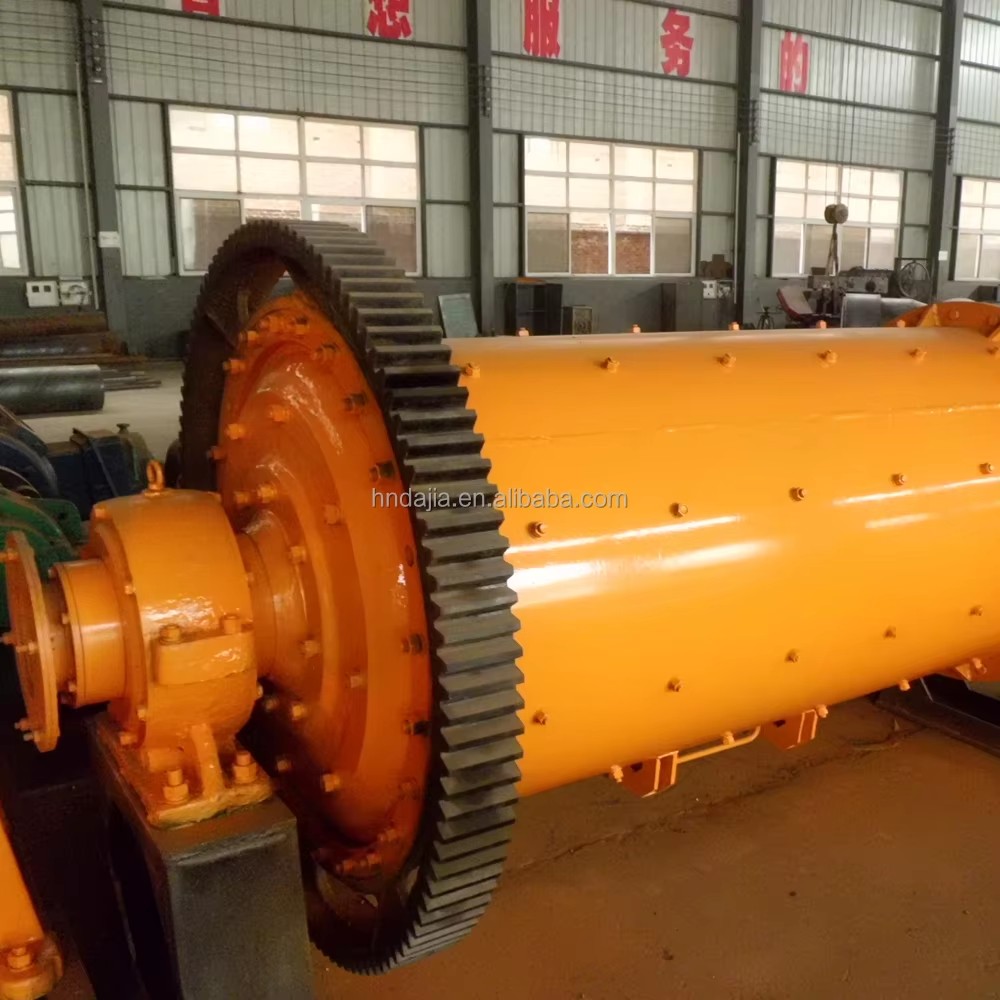
Grinding elements in ball mills travel at different velocities. Therefore, collision force, direction and kinetic energy between two or more elements vary greatly within the ball charge. Frictional wear or rubbing forces act on the particles, as well as collision energy. These forces are derived from the rotational motion of the balls and movement of particles within the mill and contact zones of colliding balls.
By rotation of the mill body, due to friction between mill wall and balls, the latter rise in the direction of rotation till a helix angle does not exceed the angle of repose, whereupon, the balls roll down. Increasing of rotation rate leads to growth of the centrifugal force and the helix angle increases, correspondingly, till the component of weight strength of balls become larger than the centrifugal force. From this moment the balls are beginning to fall down, describing during falling certain parabolic curves
Technical Detail
Shell Diameter: 900mm
Shell Length: 1800mm
Rotary Speed: 36r/min
Ball load (grinding media): 1.5t
Feeding size: ≤20mm
Motor: 18.5kw
Gearbox: JR10
Volume: Approx. 1.15m3
Output size: 0.074-0.4mm
Capacity: 0.6-1.5t/h
Weight: 4.6t
Shell Material: Q235

-
Step 1
Payment and order readiness
Minimum order: 1 Units
Payment terms, specifications, and order details are confirmed before preparation begins.
-
Step 2
Preparation
15 days
-
Step 3
Packaging and dispatch
Packaging details are available on request.
Final packing, freight, and delivery dates are confirmed before dispatch.
Customer reviews
No reviews yet
Be the first customer to review this product.
Write a review
Request custom sourcing
Can’t find what you’re looking for? Share the requirement and our sourcing team will find the right industrial product.