Product Description
HXJQ
Ore beneficiation is the process that based on differences in physical and chemical properties of various minerals in the ore. After the ore is crushed and ground, methods such as gravity separation, flotation, magnetic separation, CIP, and CIL are used to separate useful minerals from gangue and to achieve maximum separation of associated valuable minerals. This process also removes or reduces harmful impurities, improves the ore grade of useful minerals to meet the requirements for smelting or other industrial applications. This increases the value of the ore, improves recovery rates, optimizes resource utilization, reduces environmental impact, and contributes to cost-effectiveness.
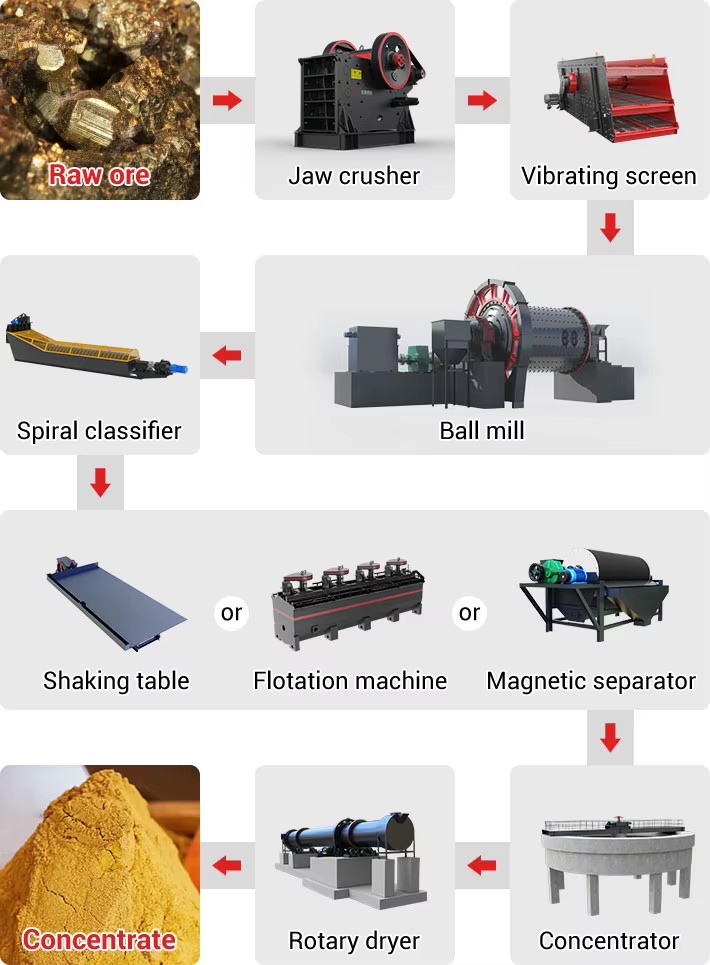
Ore beneficiation process flow
Raw Ore → Crushing, Screening → Grinding + Classification → Separation (Gravity / Flotation / Magnetic Separation) → Concentration → Filtration → (Drying) → Concentrate
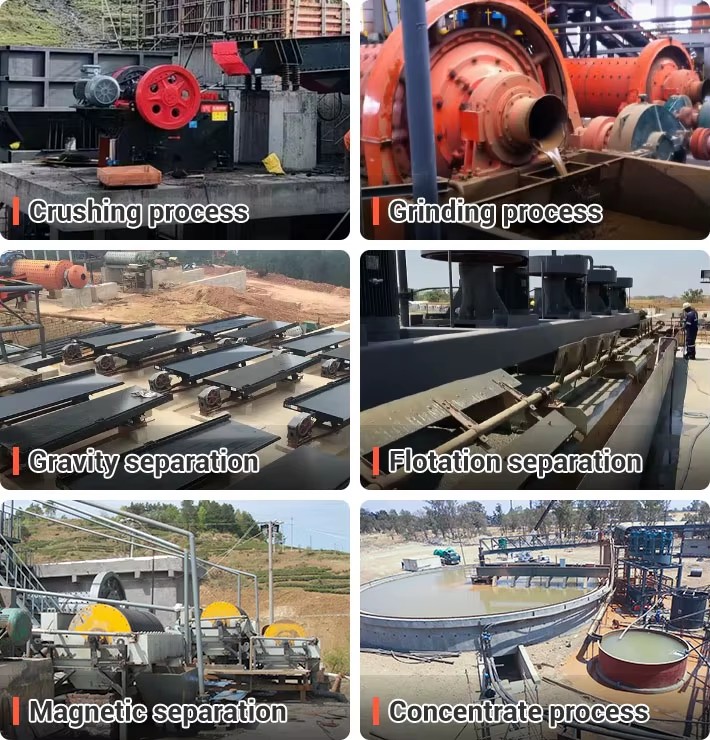
1. Crushing and Screening
(1) This is the first step in mineral processing, the raw ore is crushed by crushers to below 20 mm. and then separated into different particle sizes by screening equipment to facilitate the subsequent grinding operation.
(2) Common crushing and screening processes include two-stage and three-stage processes. For harder ore requiring a higher crushing ratio, a three-stage crushing process is used, sometimes with a pre-selection process.
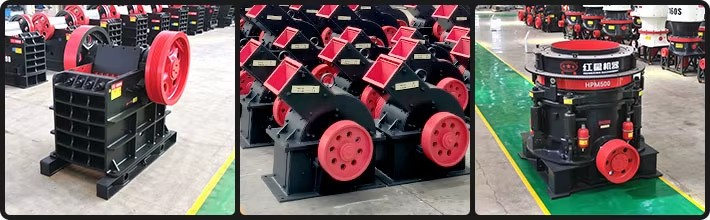
(3) Equipment: jaw crusher/hammer crusher (coarse crushing), cone crusher (medium/fine crushing)
2. Grinding and Classification
(1) The crushed ore (<20mm) is further ground to 0.074-0.4mm (35-200 mesh) to fully separate the useful minerals from the gangue minerals. The ground slurry passes through the classifier, where the qualified fine-grained slurry is sent for separation circuit, while the unqualified coarse-grained slurry is returned to the grinding mill for further grinding.
(2) Depending on the requirements of the separation process, the grinding and classification process is divided into single-stage, two-stage, or multi-stage closed-circuit flows.
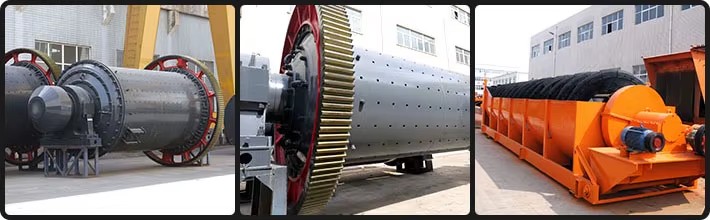
(3) Equipment: ball mill/rod mill/autogenous mill/semi-autogenous mill/wet pan mill, spiral classifier/high-frequency screen/hydrocyclone
3. Separation
(1) This is the core process of mineral processing. Based on the ore's properties and the separation requirements, appropriate separation methods (one or more combined processes) are selected, such as flotation, magnetic separation, gravity separation, carbon-in-pulp(CIP), or cyanidation(CIL), to separate the ground slurry into concentrates and tailings.
(2) This process includes the separation stage (consisting of a grinding process followed by subsequent separation), the separation circuits (groups of separation operations that produce one or
(3) Equipment: jig/shaking table/spiral chute/centrifugal concentrator, flotation machine, magnetic separator
4. Dewatering
(1) The concentrate and tailings, which contain a large amount of water after separation, are concentrated, filtered, and drying to produce solid products suitable for storage, transportation, and further processing.
(2) Coarse products from gravity separation and magnetic separation can undergo a single-stage dewatering process using settling tanks, dewatering screens, or dewatering bins for thickening or filtration. Fine products produced by flotation often undergo a two-stage or multi-stage dewatering process, such as thickening-filtration or thickening–filtration–drying.Tailings dewatering generally using a single-stage thickening process, with the recovered water returned to the mineral processing plant for reuse.
(3) Equipment: concentrator, filter press, disc vacuum filter, rotary dryer
Common mineral ore processing methods
1. Gravity Separation—Physical Separation, Most Economical and Environmentally Friendly
Utilizes the differences in specific gravity (density) between different minerals to achieve separation in water or air stream.
(1) Processing Materials: Placer gold, alluvial gold, rock gold, gold-quartz ore, tin ore, tungsten ore, chrome ore, manganese ore, rare metal and precious metal ores (such as tantalum, niobium, zirconium, titanium, and platinum group metals), pre-treatment (separating part of coarse gangue or useful minerals before flotation or magnetic separation).
(2) Used Equipment: shaking table, spiral chute, jigs, centrifugal concentrator
2. Flotation Separation—Chemical Separation, The Most Widely Used Method
Utilizing differences in the surface chemical properties (hydrophilicity/hydrophobicity) of minerals, with the aid of flotation reagents, useful minerals or unwanted impurities selectively attach to air bubbles to achieve separation, it includes forward flotation (for useful minerals) and reverse flotation (for removing impurities, such as sulfur, silica removal).
(1) Processing Materials: Non-ferrous metals (such as copper, lead, zinc, sulfur, and molybdenum, etc); certain ferrous metals, rare metals, and some non-metallic ores (such as graphite, phosphate); polymetallic gold-bearing ores (such as gold-copper, gold-lead, gold-antimony, gold-copper-lead-zinc-sulfur, etc.).
(2) Used Equipment: crushers, ball mill/autogenous mill(AG mill)/wet pan mill, spiral classifier/high-frequency screen/hydrocyclone, flotation machine(roughing, concentrating, and scavenging stages), concentrator, dryer (selected as needed), etc.
3. Magnetic Separation—For Wet Beneficiation and Dry Iron Removal
Utilizes the differences in the magnetic properties of minerals to separate and classify strong, medium, and weakly magnetic minerals.
(1) Processing Materials: Processing Materials: suitable for wet magnetic separation of materials under 3mm, such as magnetite, pyrrhotite, ilmenite, roasted ore, hematite, limonite, and manganese ore. It’s also used for iron removal of coal, non-metallic minerals (e.g., quartz, feldspar, kaolin), and construction materials.
(2) Used Equipment: crushers, ball mill/autogenous mill(AG mill), spiral classifier/high-frequency screen/hydrocyclone, magnetic separator(roughing, concentrating, and scavenging stages), concentrator, dryer (selected as needed), etc.
4. Cyanidation Gold Extraction Process—CIP, CIL
This method uses activated carbon to directly adsorb and recover gold from cyanide ore slurry through a non-filtered carbon-in-pulp process.
CIP (Carbon-in-Pulp): refers to the process in which carbon adsorption is performed after cyanide leaching. CIL (Carbon-in-Leach): in this process, leaching and adsorption occur simultaneously.
Both processes adsorb gold from the slurry, there's no essential difference, the difference being whether they occur simultaneously. The difference is that in the CIP process, leaching and adsorption occur in separate tanks, while in the CIL process, leaching and adsorption occur in the same tank, called a leaching-adsorption tank or a carbon-in-leach tank.
Comparison Table of the Advantages of the Three Major Ore Beneficiation Methods
| Comparison Dimension | Gravity Separation | Flotation Separation | Magnetic Separation |
|---|
| Separation Principle | utilize density differences between minerals | utilize differences in physical and chemical properties of mine | utilize differences in magnetic properties between minerals |
| Core Advantages | extremely low cost, environmentally friendly, simple process | high separation efficiency, wide applicability, high sorting precision | simple and efficient process, environmentally clean, easy to automate |
| Operating Cost (OPEX) | ♥♥♥ low (low energy consumption, backgroundno reagents required) | ♥ high(high reagent consumption, higher energy consumption) | ♥♥ medium-low (no reagents required, main cost is electricity) |
| Environmental Impact | ♥♥♥ minimal (no chemical pollution, clean tailings) | ♥ High (produces wastewater containing chemicals, requires strict treatment) | ♥♥♥ minimal (no chemical pollution, clean production) |
| Separation Precision | medium (less effective for fine particles and similar-density minerals) | ♥♥♥ high (effectively separate complex, fine-grained associated minerals) | high (only suitable for minerals with magnetic differences) |
| Processing Particle Size | wide range (from a few millimeters to tens of microns) | ♥♥♥ very wide range (especially suitable for fine and ultra-fine minerals) | wide range |
| Process Complexity | ♥♥♥ simple (equipment is easy to operate and maintain) | ♥ complex (requires strict control of parameters like reagent dosage, pH, air volume, etc.) | ♥♥♥ simple (easy to operate and readily automated) |
| Typical Application Minerals | gold, tin, tungsten, coarse-grained iron ore, coal, and other minerals with large density differences | most minerals, such as copper, lead, zinc, molybdenum, antimony, and fine-grained iron ore | magnetite, ilmenite, manganese ore, and other magnetic minerals (mainly used for iron ores) |
| Main Limitations | poor separation effect for slimes and minerals with similar densities | high cost, significant environmental concerns, complex process flow | narrow application range, to magnetic minerals |
Summary: In actual mineral processing plants, these methods are often combined into integrated flowsheets to maximize their respective advantages and achieve the highest resource recovery and economic efficiency.
The beneficiation equipment can be different according to your demands. like the ore type, capacity, concentrate grade, etc. We offer hundreds of solutions for you to choose from, for detailed process designs, flowsheets and quotations, please
Service Process
Specialized technical training and instructions
Certificate
All products have passed international certifications such as ISO 9001, CE, and GOST. Machine with reliable and stable quality has made the company's production, sales, and comprehensive economic indicators rank among the industry's leading positions.